Mental Momentum Moments
The end of each episode focuses on a "Mental Momentum Moment" that gives listeners a practical, purposeful resource or coping strategy they can use right away.
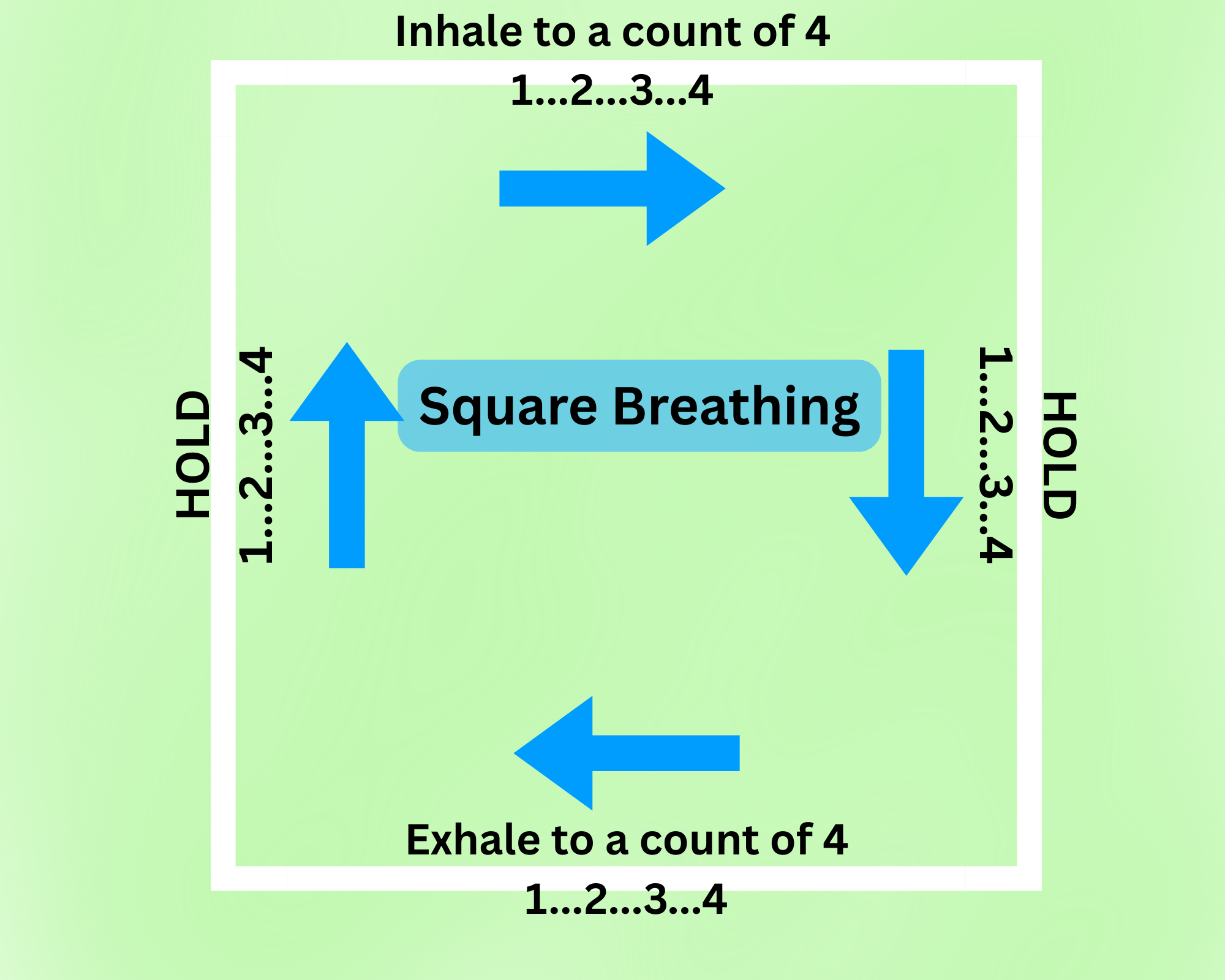
square breathing
SQUARE BREATHING — an old one, tried and true. This technique works so well to center and calm the nervous system. 5–7 rounds of this will do wonders for your nerves — give it a try!
Inhale through your nose for a count of four…
Hold for a count of four…
Exhale thorugh your mouth for a count of four…
Hold for a count of four…
You have the option to draw a square with a pen and paper, trace one with your finger on your leg, or simply visualize it in your mind — with each side representing: inhale, hold, exhale, hold.
visualization-progressive
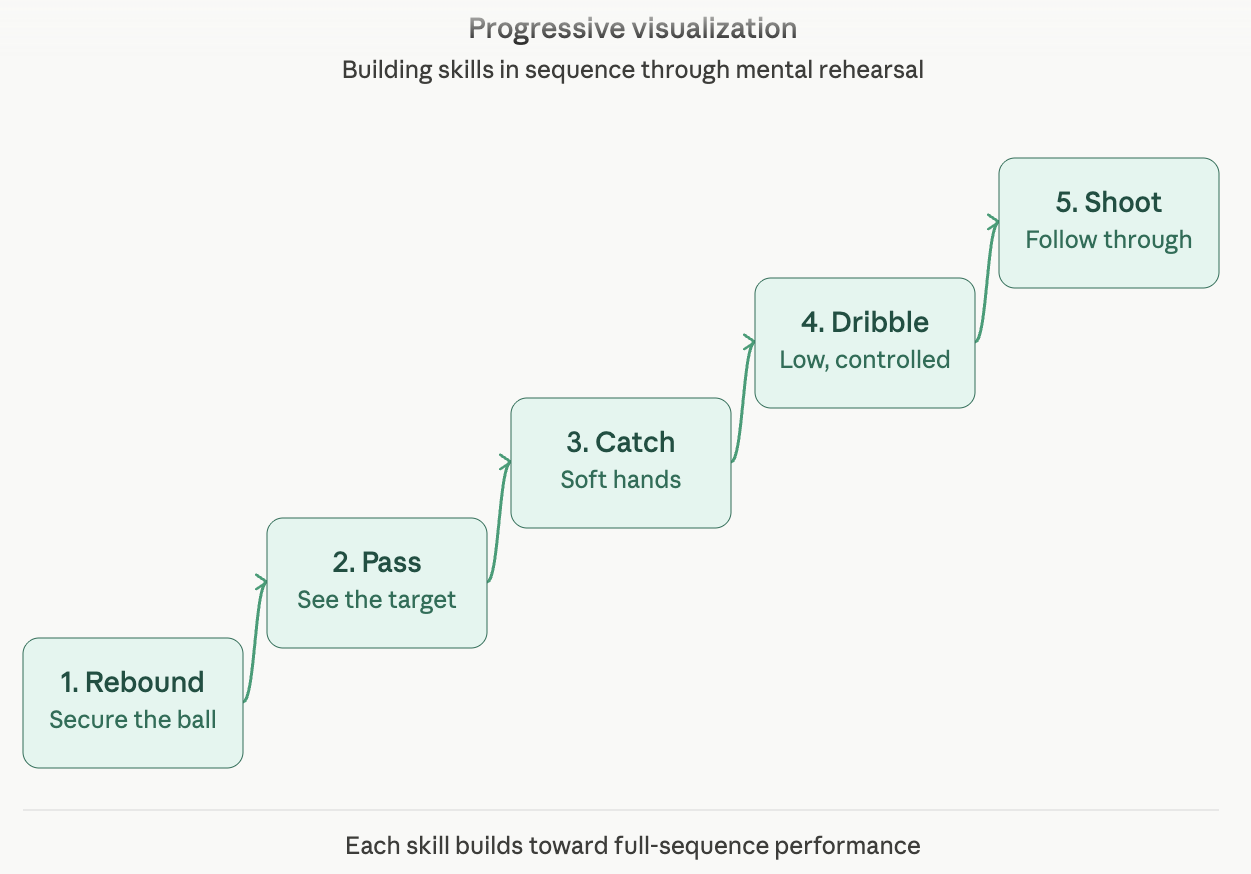
Progressive Visualization is the mental practice of rehearsing individual skills in their natural competitive sequence — building from one action to the next until the full performance plays out in the mind from start to finish. Rather than isolating a single skill, the athlete mentally executes each step as it would unfold in real competition, allowing the brain to rehearse not just the skill itself but the transition between skills. The result is a complete, fluid mental blueprint for performance. Remember to see the images like you are on the sideline, or watching a video of yourself.
Trains the brain to move fluidly between skills — not just perform each one in isolation
Reduces hesitation and decision-making lag during live competition
Reinforces muscle memory for multi-step sequences under pressure
Builds a complete performance script the mind can return to automatically when it counts
Here is an example using basketball:
Rebound it — Visualize your body positioning, the jump, the contact with the ball, and securing it with two hands. Feel the physical weight and momentum of the grab.
Pass it — From the rebound, immediately see the open teammate. Visualize your eyes finding the target, your hands snapping the pass with precision and intent.
Catch it — Now become the receiver. Visualize the ball arriving, your hands extending with soft, ready fingers, the sound of the ball hitting your palms, the grip.
Dribble it — Feel the ball meeting the floor — low, controlled, and rhythmic. Visualize your eyes scanning the court, your body protecting the ball under pressure.
Shoot it — See the release, the arc, the follow-through. Visualize the ball traveling through the net. Feel the confidence and the completion of the sequence.
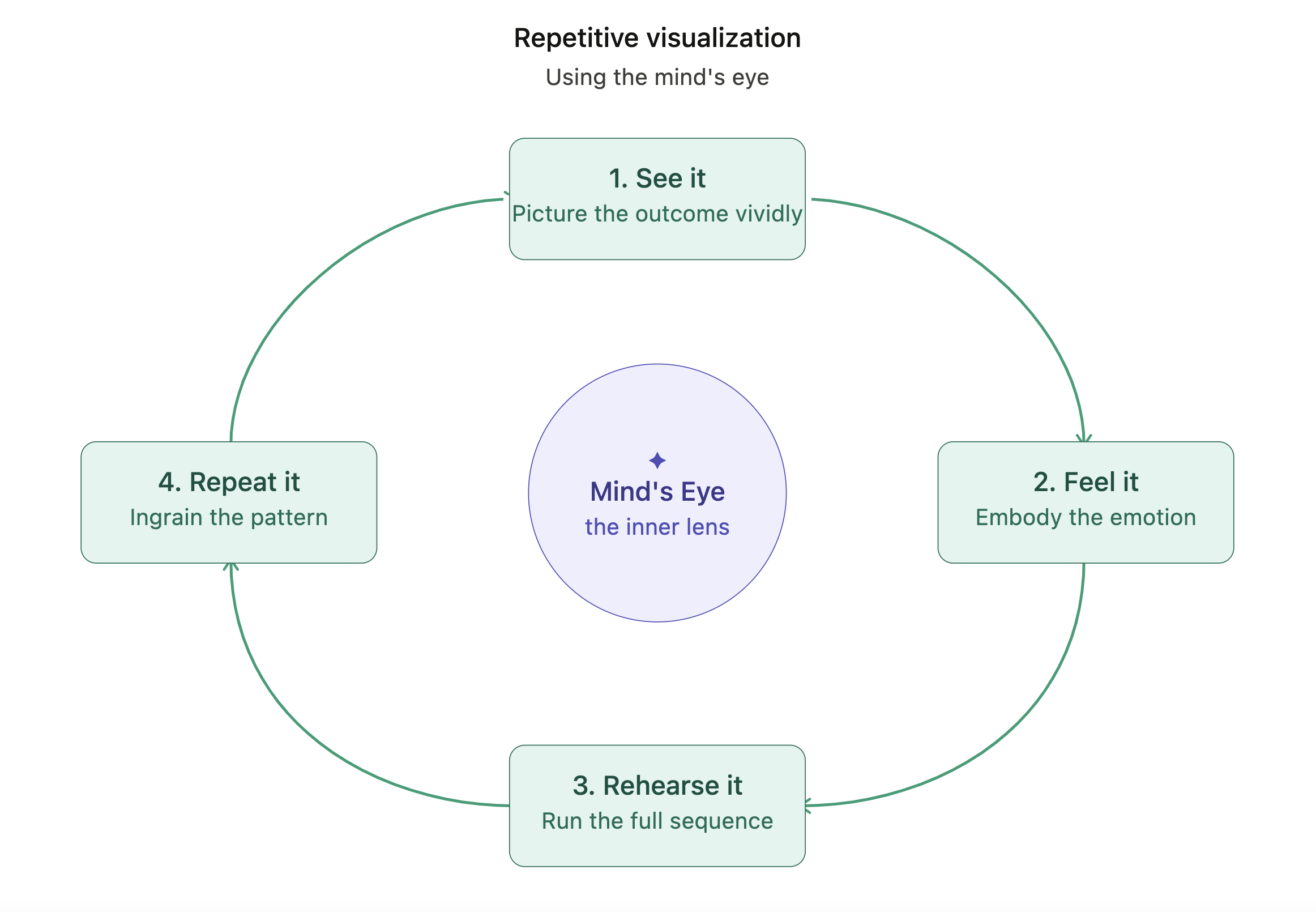
VISUALIZATION-REPETITIVE
1. See it — picture the outcome vividly
Close your eyes and create a full-color, first-person mental image of the performance
Include environmental details: the sound of the crowd, the lighting, the feel of the equipment
Specificity matters — a blurry image produces a blurry result
2. Feel it — embody the emotion
Attach authentic emotion to the image: confidence, focus, joy, determination
Feeling the visualization activates the body's stress-response and reward systems the same way real experience does
Notice the physical sensations — heart rate, muscle tension, breathing — and regulate them within the vision
3. Rehearse it — run the full sequence
Walk through the performance step by step in real time, not fast-forward
Include the moments before, during, and after — the full arc, not just the highlight reel
Use all five senses to make it as real as possible to the subconscious mind
4. Repeat it — ingrain the pattern
Repetition is where visualization becomes a competitive tool, not just a relaxation exercise
Daily practice (even 5–10 minutes) builds a neural groove that the body returns to under pressure
The mind doesn't distinguish well between a vivid imagined rep and a physical one — use that to your advantage
The bottom line: Repetitive visualization isn't daydreaming — it's deliberate mental rehearsal. The mind's eye is a trainable skill, and the more clearly and consistently you use it, the more automatic excellence becomes when it counts.
goal-gratitude journal
Goal-Gratitude Journals are used to develop focus, motivation, and self-efficacy. At night, write down three things you are grateful for and three goals for the next day. The following night, review your goals and reflect on whether you hit them and why or why not. Then write three more things you are grateful for. This process instills the intrinsic joy that gratitude provides along with the drive and motivation that goals provide.
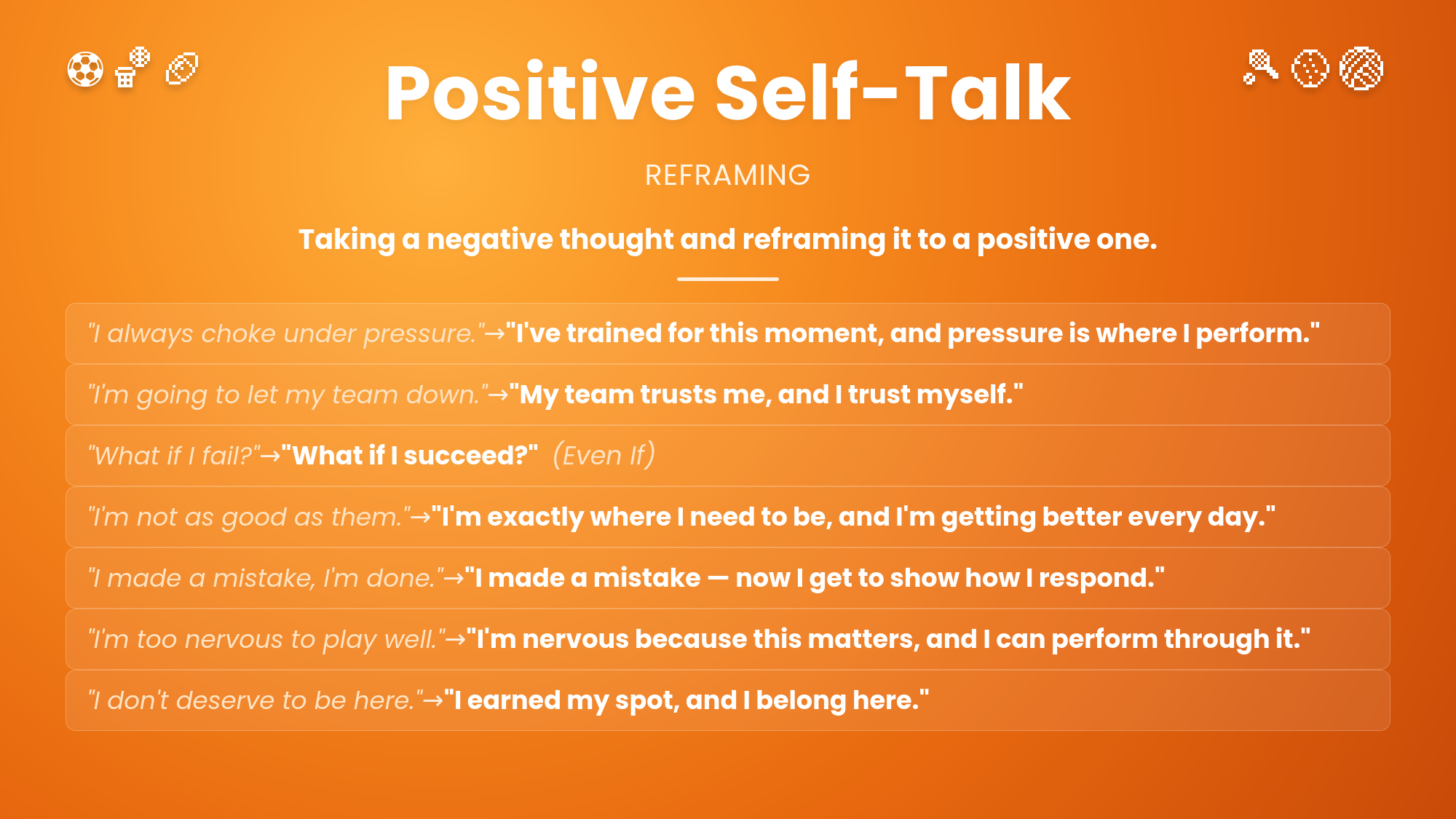
Positive self-talk - reframing
-
![Flowchart demonstrating breathing exercises, beginning with inhaling to a count of four, followed by exhaling to a count of four, with arrows and instructions for each step.]()
You don’t have to be stressed to benefit from this breath exercise (Square/box breathing). Practicing box breathing is an opportunity to bring mindfulness to your breath, which is a valuable practice even in tranquil times. “It allows you to slow your breath, and it also has an aspect of meditation,” Integrative medicine specialist Dr. Melissa Young says. “As you’re breathing, you’re also silently counting, which is a kind of mantra meditation that, again, calms the nervous system and brings you into the present moment.
Article: Cleveland Clinic
-
![]()
"When Dr. Hopkins showed me square breathing, it was so simple, yet made such a big difference in my approach. I use it on a regular basis on the course"
Former Sports Client
-
![A football positioned on a football field with green turf and white yard lines.]()
"Square breathing is something I do on the sideline, even in the huddle. It gets me ready for the next play."
Sports Client
-
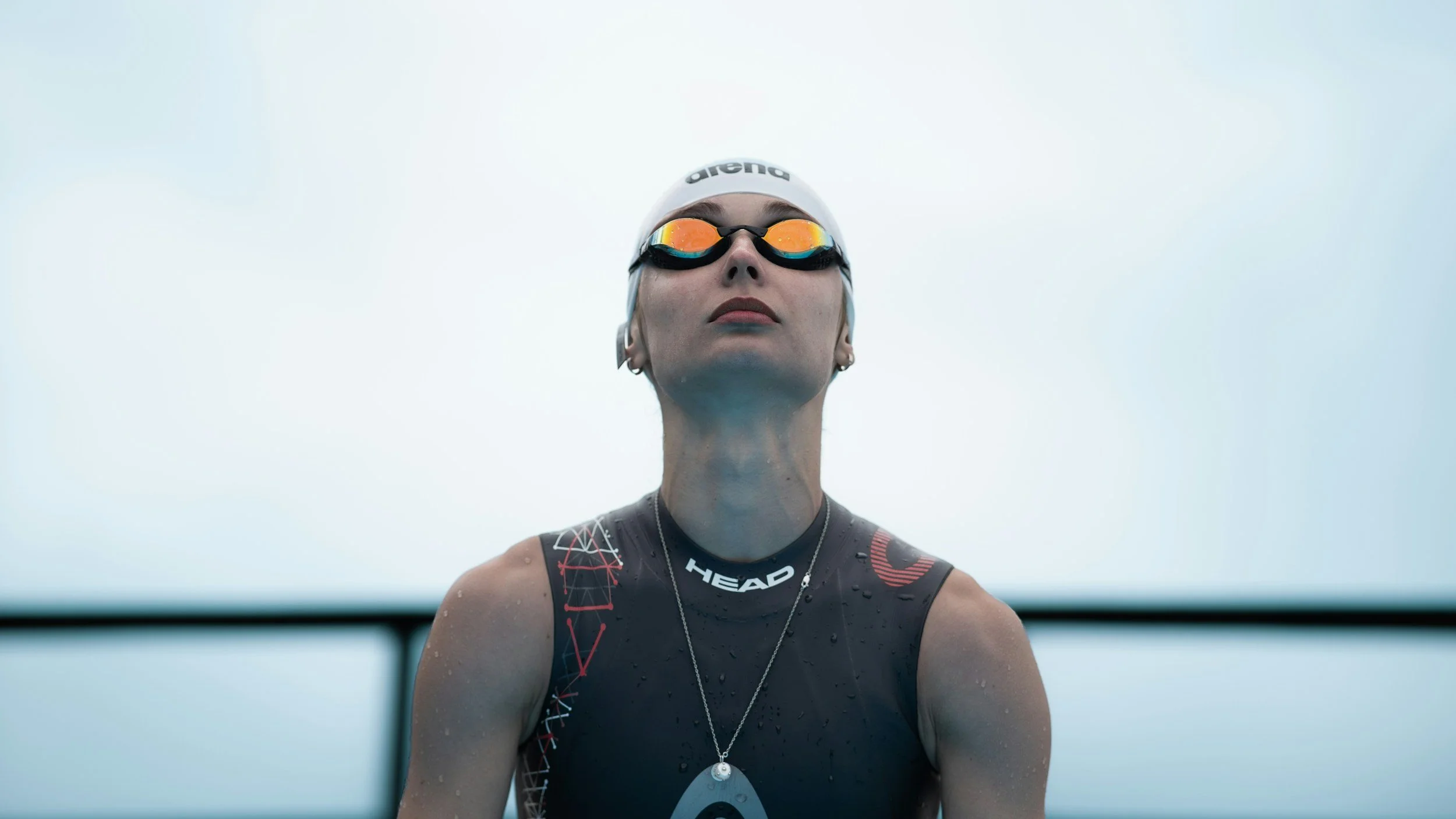
![A female athlete wearing swimming goggles, a swim cap, and a black athletic suit with dew drops, looking upward with a serious expression.]()
Visualization
“Visualization is a game-changer. Dr. Hopkins taught me different ways to visualize, and it’s been the biggest influence on my performance and mental game.”
Former Sports Client
-
![A black and white photo of a football player sitting on a bench in a locker room, surrounded by teammates. The player appears contemplative, wearing a football uniform with the number 44 and a helmet placed on the floor nearby.]()
Visualization
“I have used repetitive visualization for a long time, but Dr. Hopkins showed me how to use progressive visualization and walked me through a competition. It was exhilarating! I was focused, confident, and energized before the event.”
Sports Client